


27th-30th Nov, 2026 Labhganga Exhibition Center, Indore
5th INTERNATIONAL PLASTICS EXHIBITION
5th INTERNATIONAL PLASTICS EXHIBITION
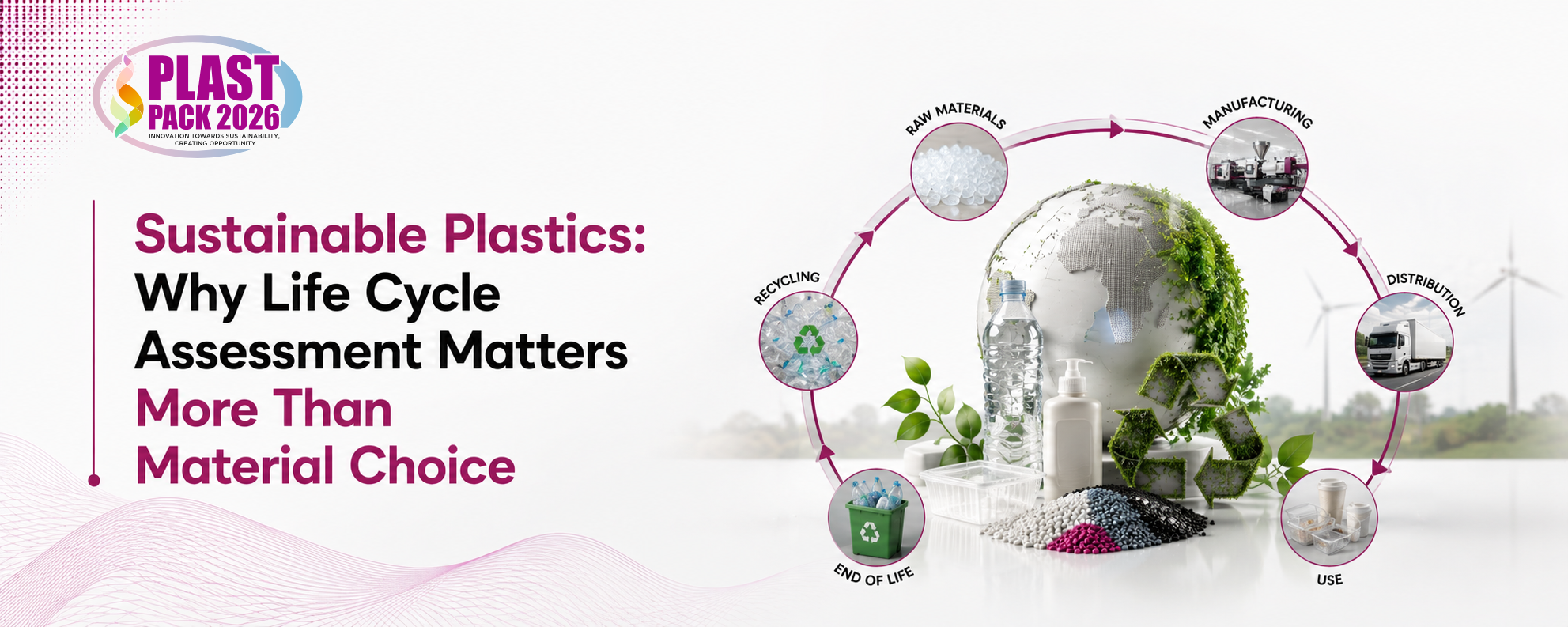
All plastic vs paper discussions fail to address the most important issue. Sustainability is not just an origin-based thing; it is what a material does throughout its life. Manufacturers can now see the way forward towards real sustainability with the help of Life Cycle Assessment with regard to industrial plastics.
At first glance, paper seems to be an “environmentally friendly” option. However, paper uses more water and energy than a lot of the plastic options. The true environmental impact is changed by transport weight, durability and recyclability. A single-material comparison does not consider impacts for the manufacturing, distribution and disposal of the material.
Indian manufacturers should be more expansive. When it comes to selecting materials based on partial information, it results in misleading sustainability claims and money being wasted.
Life Cycle Assessment is the assessment of the environmental impact of a product, which is carried out from the beginning of the use of raw materials until the time of disposal. It measures energy consumption, emissions, water usage and end-of-life.
This approach not only draws attention to the packaging that sounds green, but also to those that actually are. LCA information helps businesses make informed and more strategic sourcing choices when investing in industrial plastics.
Light packaging made from plastics consumes less fuel during transportation. Reducing the amount of material also reduces emissions produced in the manufacturing process. Indian FMCG and pharma companies are increasingly using thinner and stronger films to achieve both the cost and carbon targets. Each gram saved in packaging design multiplies in millions of packages shipped across the country.
It is difficult to economically recycle multi-layer packaging. Mono-material design makes sorting easier and greatly increases the amount of recovery. Single-polymer structures result in improved recyclability without compromising barrier properties for brands making the transition. This change demands new plastic machinery with accurate processing for new material specifications.
The progress of the technology of recycled polymers is remarkable in the last few years. Nowadays, manufacturers are able to get near-virgin quality with post-consumer recycled resins.
Circular manufacturing models are closed-loop processes that close the material cycle between production, use, and recovery. Today, India’s packaging industry is speeding up the adoption of these innovations at a quick pace.
Manufacturers are under pressure to be accountable due to regulatory obligations and consumer expectations. Companies are now quantifying impact instead of assuming it. It is a data-driven approach that is being talked about at the Plast Pack forum and is changing the way plastics are sourced, designed and produced throughout India’s plastics industry.
Plast Pack 2026 is bringing together manufacturers, innovators and suppliers of sustainable plastics and plastic machinery solutions. LCA-based design, recycled polymers and circular manufacturing processes will be highlighted during the discussions of the Plast Pack Forum.
Come to Plast Pack 2026 in Indore, 27th-30th November, to experience live demonstrations of sustainable packaging technology. Become a member now and interact with the top innovators in the plastics and packaging industry in India.
© Plastpack 2026 | Designed by Whiteelephanttech